Angkhana Has Not Made Any Public Statement About the Government Following the Deaths of Thai Ranger Officers
Thai PBS Verify identified the source of the claim: Facebook
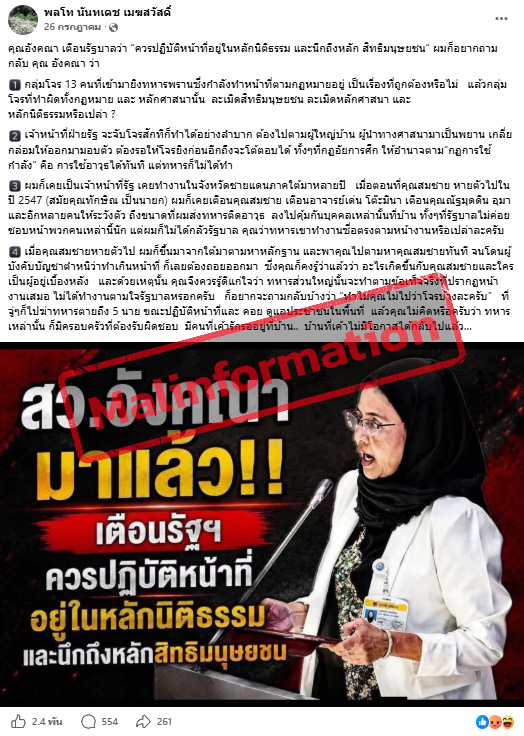
Following the attack in which assailants opened fire and threw explosives at a Thai Ranger checkpoint in Ra-ngae District, Narathiwat Province, Thai PBS Verify found a Facebook post published by the account “Lieutenant General Nuntadej Meksawat.” A subsequent verification confirmed that the account belongs to Lt. Gen. Nuntadej Meksawat, former Head of the Special Operations Center at the National Security Center (NSC).
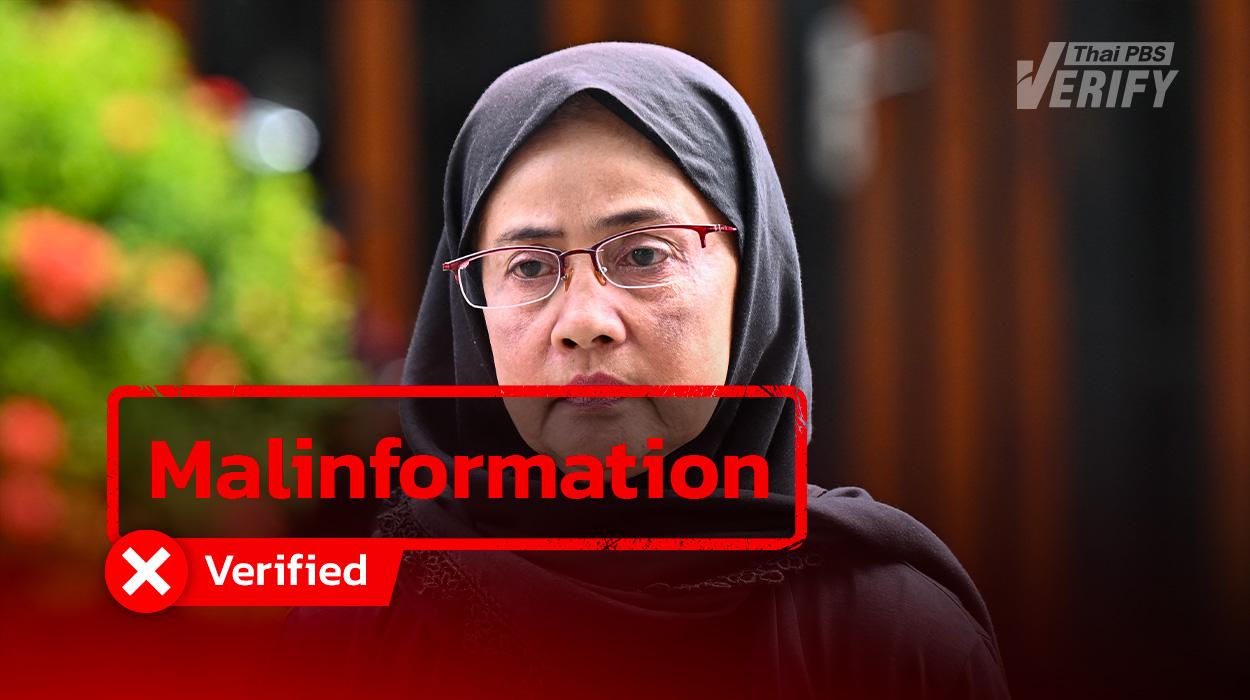
The post claimed that Angkhana Neelapaijit, a senator and human rights advocate, had stated that the government should carry out its duties in accordance with the rule of law and with respect for human rights. The post stated:
“Ms. Angkhana warned the government that ‘it should carry out its duties in accordance with the rule of law and uphold the principles of human rights.’ I would like to ask Ms. Angkhana in return:
Were the 13 insurgents who attacked Thai Ranger officers carrying out their lawful duties acting correctly? And did those insurgents, by violating both the law and religious principles, also violate human rights, religious principles, and the rule of law?
State officials already face great difficulty in apprehending insurgents. They must summon village heads and religious leaders to act as witnesses, persuade suspects to surrender, and even wait until they come under fire before responding. Although martial law authorises the immediate use of weapons under the rules of engagement, the military has not exercised that authority.”
“I, too, was once a state official and worked in Thailand’s southern border provinces for many years. When Somchai disappeared in 2004, during Thaksin Shinawatra’s administration, I warned Somchai, Den Tohmeena, Natmuddin Uma, and several others to be careful. I even deployed armed soldiers to protect them at their homes, despite the fact that the government was not particularly fond of these individuals. I was not afraid of the government. Do you think the soldiers were not carrying out their duties honestly and professionally?
After Somchai disappeared, I immediately returned from the South to gather evidence and accompanied you in the search for him. I was later reprimanded by my superiors for exceeding my authority and had to step back. You know what happened to Somchai and who was behind his disappearance. For that reason, you should know very well that most soldiers carry out their duties based on the facts before them—they do not simply act according to the wishes of the government.
So let me ask you this: Why don’t you condemn the insurgents as well? They suddenly killed five Thai Ranger officers while the officers were carrying out their duties and protecting local communities. Don’t you think those soldiers also had families to support—loved ones waiting for them at home… a home they will never have the chance to return to?”
The post received more than 2,000 reactions and was shared more than 230 times.
Did Angkhana Really Make a Statement About the Government Following the Attack on the Thai Ranger Officers?
Thai PBS Verify examined the claim using Google Lens to verify the accompanying image. The investigation found no trace of the image or any related report from credible news organisations or official agencies, and no evidence that it had ever been published as an official news image.
A search using relevant keywords found only a report by PostNews, stating that Lt. Gen. Nuntadej Meksawat, former Head of the Special Operations Center at the National Security Center (NSC), had published a Facebook post referring to Angkhana Neelapaijit, as quoted above. However, Thai PBS Verify found no evidence confirming that Senator Angkhana actually made the statement attributed to her.
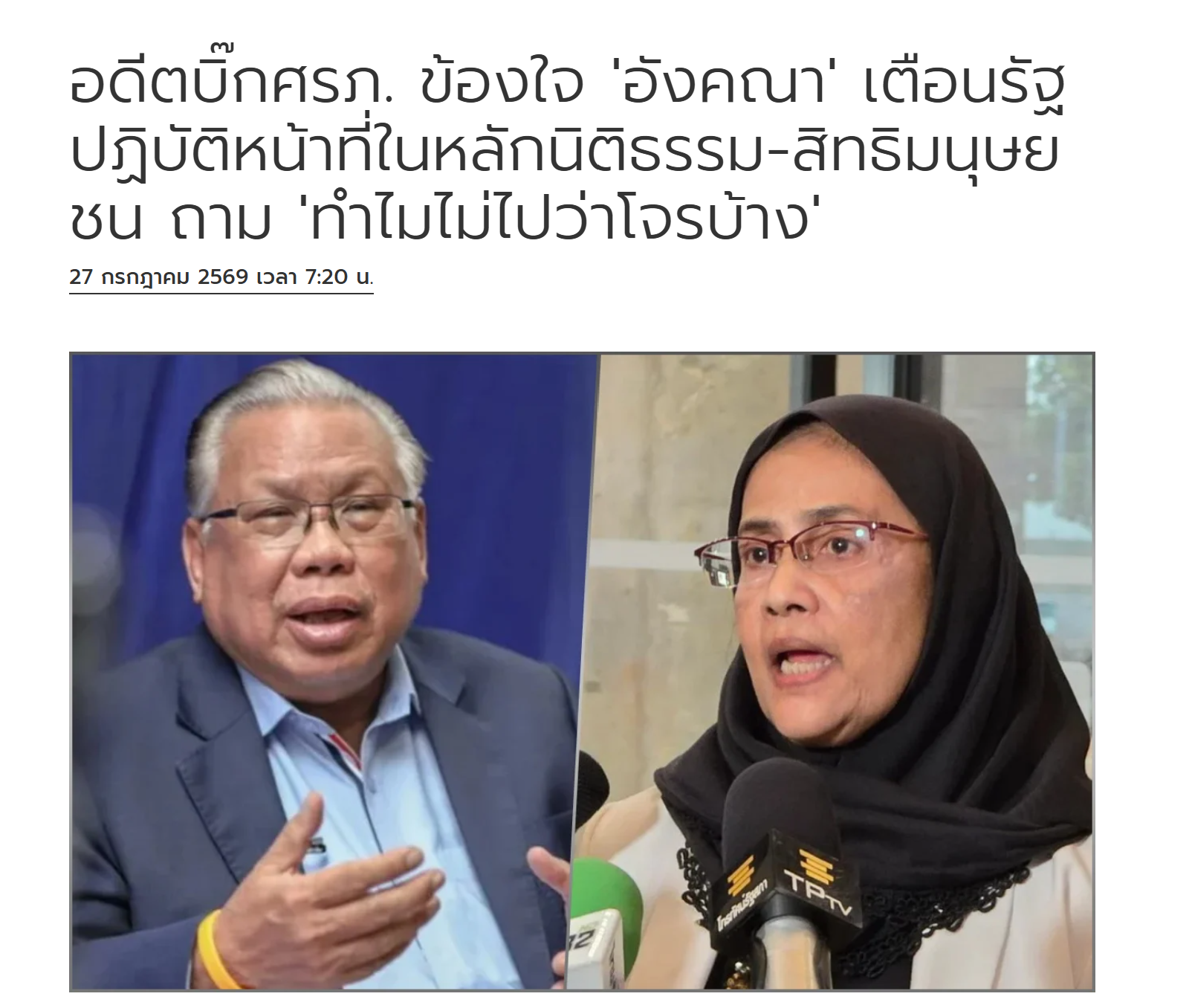
The report from ThaiPost
Thai PBS Verify contacted Angkhana Neelapaijit, a senator, who confirmed that following the attack in which assailants opened fire and threw explosives at a Thai Ranger checkpoint in Narathiwat Province, she had not made any public comment, given any interviews, or published any statement regarding the incident.
Angkhana further explained that although the Fourth Army Region had announced an expansion of martial law to facilitate search and cordon operations, there had so far been no information or complaints indicating that authorities had exceeded their legal powers or committed human rights violations. Therefore, she said, there had been no reason for her to comment on the matter.
“If there were human rights violations, I might express concern. But at this point, no members of the public have filed complaints that they have suffered harm or been adversely affected, so I have not made any comment.”
Angkhana added that, as a matter of principle, the state has the legal authority to declare and extend the enforcement of martial law. However, she stressed that officials must carry out their duties in accordance with the rule of law and within the limits prescribed by law. She reiterated that, to date, she has not received any complaints alleging that authorities have exceeded their legal powers, and therefore had no further comment on the issue.
“In Thailand, we remain under the rule of law. Personally, I believe the state has the authority to declare martial law and expand its scope of enforcement in accordance with the law. At the same time, the actions of state officials must be closely monitored. However, so far, I have not received any complaints that officials have exercised powers beyond those provided by law. Therefore, I have no further comment on this matter.”
In addition, Thai PBS Verify reviewed Angkhana Neelapaijit’s Facebook account and found no posts or comments related to the incident.
Summary of the Incident and Measures to Track Down the Perpetrators in Narathiwat Province
On 21 July 2026, Thai PBS reported that at approximately 7:20 p.m., assailants carried out an attack using a vehicle-borne improvised explosive device (VBIED) outside the former Tanyong Police Station in Kaluwo Nuea Subdistrict, Mueang Narathiwat District, Narathiwat Province.
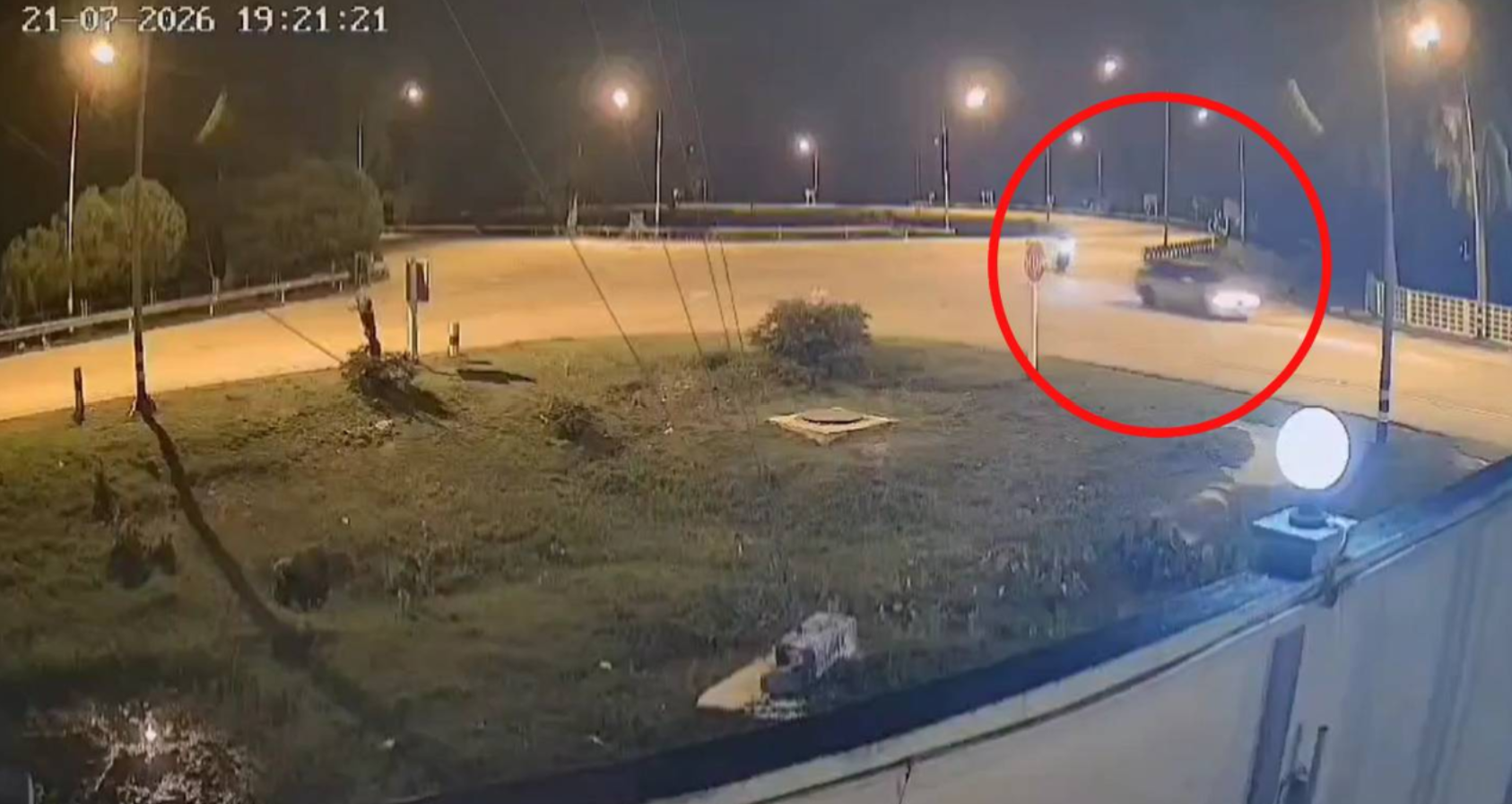
CCTV footage captured the suspects fleeing the scene after carrying out the bomb attack outside the former Tanyong Police Station.
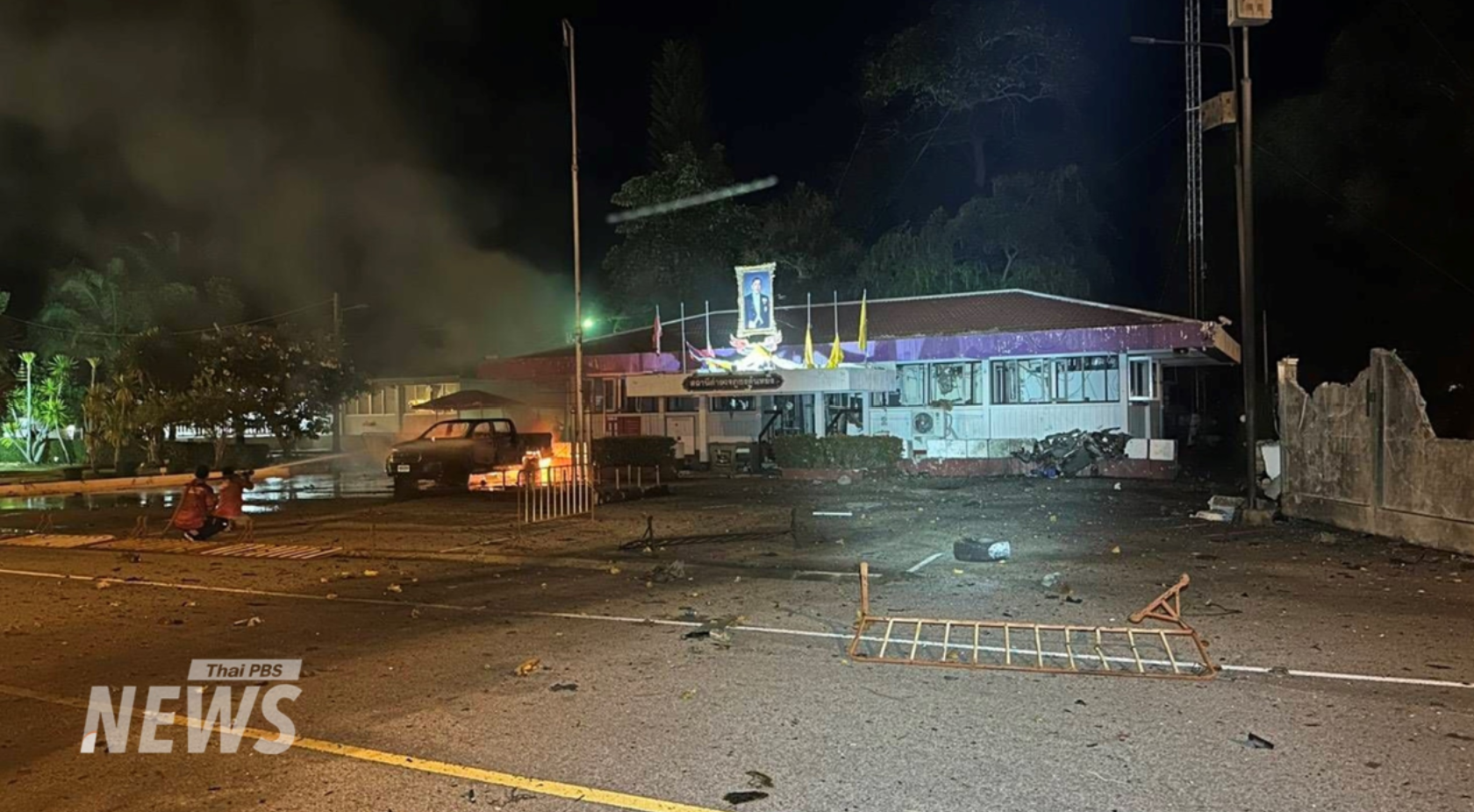
Damage caused by the explosion outside the former Tanyong Police Station.According to a Thai PBS report, on 22 July 2026, at approximately 6:45 p.m., six assailants dressed in black arrived in a black four-door Nissan pickup truck. They opened fire and threw pipe bombs at the Buketa Sami Municipal Checkpoint, located within Tanyong Mat Municipality, Ra-ngae District, Narathiwat Province, which falls under the responsibility of Ranger Company 4509.
The attack claimed the lives of five Thai Ranger officers.
Following the incident, authorities issued arrest warrants for the suspects, prompting the Narathiwat Task Force to strengthen security measures across the province. Exercising powers under the Martial Law Act B.E. 2457 (1914), authorities launched operations involving cordon-and-search missions, the establishment of security checkpoints, the arrest and detention of suspects, and coordination with civilian agencies to expedite the capture of those responsible and prevent further violence in the area. The order took effect immediately upon signing and will remain in force until further notice.
What Are the Facts ?
A post circulated on social media claiming that Angkhana Neelapaijit, a senator and human rights advocate, had stated that “the government should carry out its duties in accordance with the rule of law and with respect for human rights.”
Thai PBS Verify found no evidence confirming that Angkhana made the statement attributed to her. The investigation found no credible news reports or official sources containing the image or quotation. A keyword search located only posts by third parties claiming that Angkhana had made the statement, but no original post, interview, or public statement from Angkhana herself.
Angkhana also confirmed to Thai PBS Verify that she had never made the statement, never posted it, and never given an interview containing those remarks. She added that, following the attack on the Thai Ranger checkpoint in Narathiwat Province, she had not commented on the incident, as no complaints alleging human rights violations by state officials had been reported.
Verification Process
- Verified the accompanying image using Google Lens: Thai PBS Verify used Google Lens to examine the image and found no trace of it in reports from credible news organisations or official agencies. There was also no evidence that it had ever been published as an official news image.
- Conducted a keyword search: The search found only a report by PostNews, stating that Lt. Gen. Nuntadej Meksawat, former Head of the Special Operations Center at the National Security Center (NSC), had published a Facebook post referring to Angkhana Neelapaijit. However, Thai PBS Verify found no evidence confirming that Senator Angkhana actually made the statement attributed to her.
- Reviewed Angkhana Neelapaijit’s official communication channels: Thai PBS Verify found no posts, public statements, or interviews matching the claim.
- Verified the claim directly with Angkhana Neelapaijit: She confirmed that she had never made the statement and had not publicly commented on the incident following the attack.
Impact of the False Claim
- Misleads the public about the views of a public figure: Sharing a statement falsely attributed to a public figure without supporting evidence may lead people to believe that the individual has taken a particular position or commented on an incident when, in fact, they have not.
- Inflames tensions and deepens social divisions: The unrest in Thailand’s southern border provinces is a highly sensitive issue. Circulating unverified statements can be used to attack or discredit individuals and fuel hostility between groups with differing views, further intensifying social conflict.
- Damages the reputation and credibility of the person being impersonated: When people believe that an individual made a statement they never actually made, it can harm that person’s public image, credibility, and the trust placed in them—even if the claim is later proven false.
- Distorts the facts surrounding the incident: Focusing public attention on an unverified quotation may shift discussion away from the actual facts of the incident, the ongoing investigation, and the government’s response, resulting in a distorted public understanding of the situation.
- Accelerates the spread of misinformation: When a post receives large numbers of reactions, comments, and shares, unverified information can quickly reach a much wider audience, increasing the likelihood that more people will accept it as true and continue spreading it, making it far more difficult to correct later.
What to do with this misinformation?
- Verify the source before believing or sharing it: Check whether the claim originates from a credible news organisation, an official government source, or the official communication channels of the person being quoted. Do not assume it is genuine simply because it includes an image or has been widely shared.
- Look for the original statement: If the claim attributes a quote to a public figure, verify it through the person’s official Facebook or X account, official website, or a verified interview to confirm whether the statement was actually made.
- Be cautious of realistic-looking news graphics: It is now easy to create fake news images and graphics that closely resemble those produced by legitimate media outlets. Check whether the image was actually published by the claimed news organisation or official source. Reverse image search tools such as Google Lens can help verify its authenticity.
- Avoid sharing unverified information: Even if your intention is simply to ask questions or raise awareness, sharing unverified claims can contribute to the spread of misinformation and cause harm to individuals or society.
- Follow updates from trusted fact-checking organisations: When information relates to sensitive issues or major events, rely on findings published by reputable fact-checking organisations before accepting or sharing the claim.