2019 video recycled to allege U.S. destroyer fleeing Iranian boats
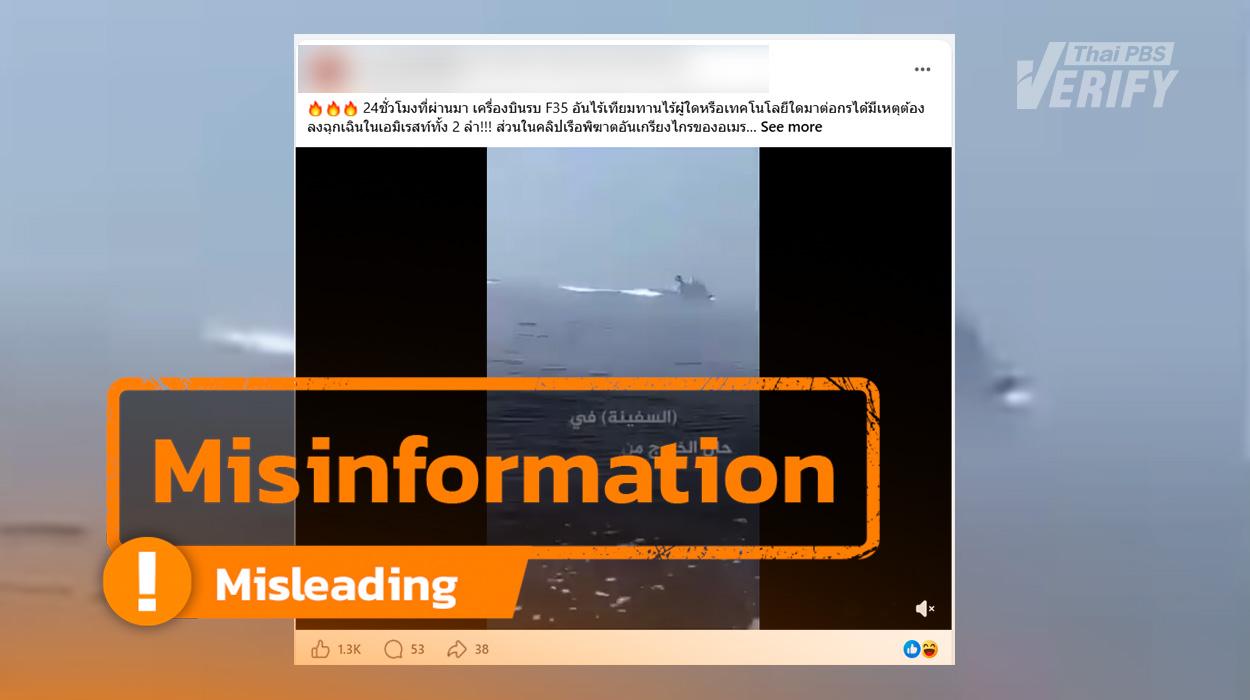
Thai PBS Verify found the piece of misinformation on: Facebook
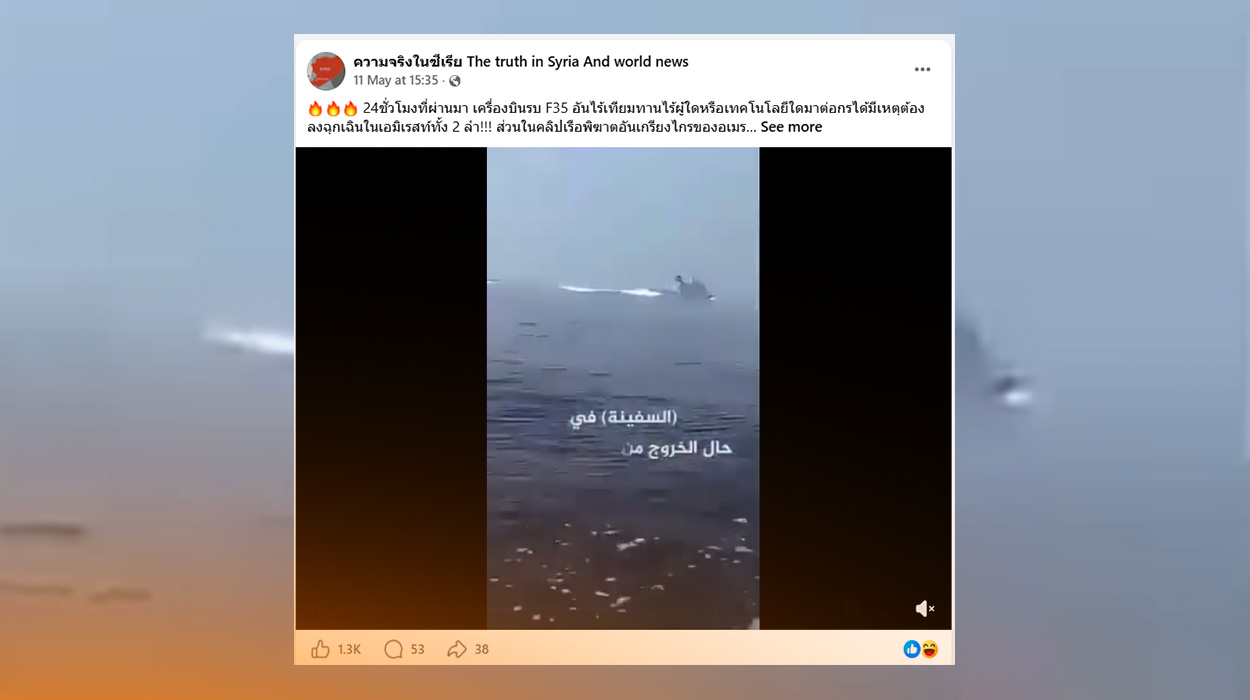
Claims of a U.S. destroyer Fleeing Iranian Gunboats in the Strait of Hormuz surface on Facebook
Thai PBS Verify discovered a video post by a Facebook page named ‘ความจริงในซีเรีย The truth in Syria And world news.’ The footage captures a distant warship being pursued by a fleet of small, machine-gun-mounted boats. The Thai caption could be translated as:
“🔥🔥🔥 Over the last 24 hours, two F-35 fighters—the ones deemed invincible and beyond the reach of any opposing technology—were forced to execute emergency landings in the UAE. Furthermore, the accompanying footage purports to show a formidable U.S. destroyer retreating hastily from pursuing Iranian speedboats 😂. An Iranian soldier is heard proclaiming: ‘Run away in shame! This is our ancestral land, not a place for invaders. Never forget that.’“♨️ Most recently, the eccentric Trump came out to argue against the evidence once again, insisting that no damage was done and that they ‘responded with decisive and flawless precision’ 🤣.
“#StraitOfHormuz
#IranUSWar
#IranIsraelWar”
The post has garnered over 37,000 views and more than 1,100 reactions, with the majority of commenters believing the claim to be true.
A U.S. F-35 did not make an emergency landing in the UAE as claimed
Thai PBS Verify conducted a keyword search on May 12, 2026, and found a report by Xinhua News Agency‘s English service regarding two U.S. Air Force F-35A Lightning II aircraft requesting emergency landings in the UAE.
The following is the Xinhua’s original report:
TEHRAN, May 10 (Xinhua) — A U.S. Air Force Lockheed Martin F-35 Lightning II fighter jet squawked 7700 emergency signal Sunday morning as it was flying over the Gulf of Oman, Iran’s semi-official Tasnim news agency reported.
After sending the emergency code, the aircraft changed course toward the United Arab Emirates and began losing altitude, the report said.
In a separate incident on Tuesday, two U.S. Air Force aircraft, namely a KC-135R Stratotanker and a Boeing KC-46 Pegasus, carrying out operations over the Gulf, squawked 7700, according to Tasnim.
It cited flight-tracking data and regional reports showing that the KC-135 Stratotanker reportedly experienced an in-flight emergency over the Gulf and Strait of Hormuz and sent a distress code before vanishing from radar.
According to Tasnim, the Boeing KC-46 Pegasus sent the code while flying in Saudi Arabia’s airspace on its way back to Israel’s Tel Aviv.
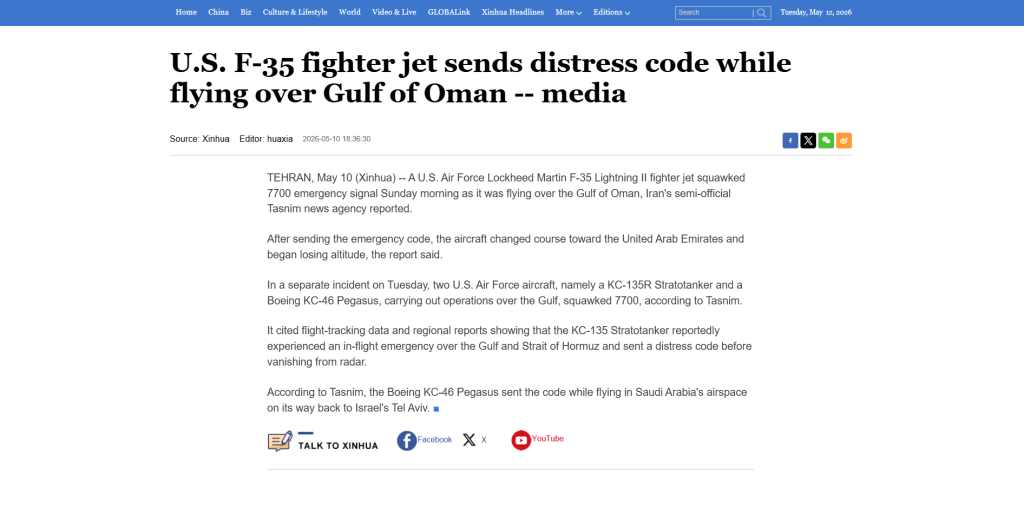
A screenshot of the Xinhua report, published on May 10, 2026.
Furthermore, a news report was found on AIRLIVE.net – an aviation news network backed by journalists and flight enthusiasts. It covered two distinct incidents of the U.S. Air Force F-35A Lightning II jets requesting emergency landings. As for the incident on May 10, 2026, the site reported that a U.S. Air Force F-35 fighter jet broadcasted an emergency signal while operating over the Gulf of Oman. The summary of the report indicates that:
At 08:12 UTC, a U.S. F-35 stealth fighter (registration 13-5067) broadcasted a 7700 general emergency signal during a mission at 10,500 feet. The incident occurred over the United Arab Emirates near the Gulf of Oman’s airspace, although the precise cause remains unidentified.
The immediate decision to divert the flight suggests there was a technical error or a major system failure. Reports say the pilot landed safely at PSAB, a main U.S. Air Force base in the Middle East that has the specific maintenance tools needed for this high-performance jet.
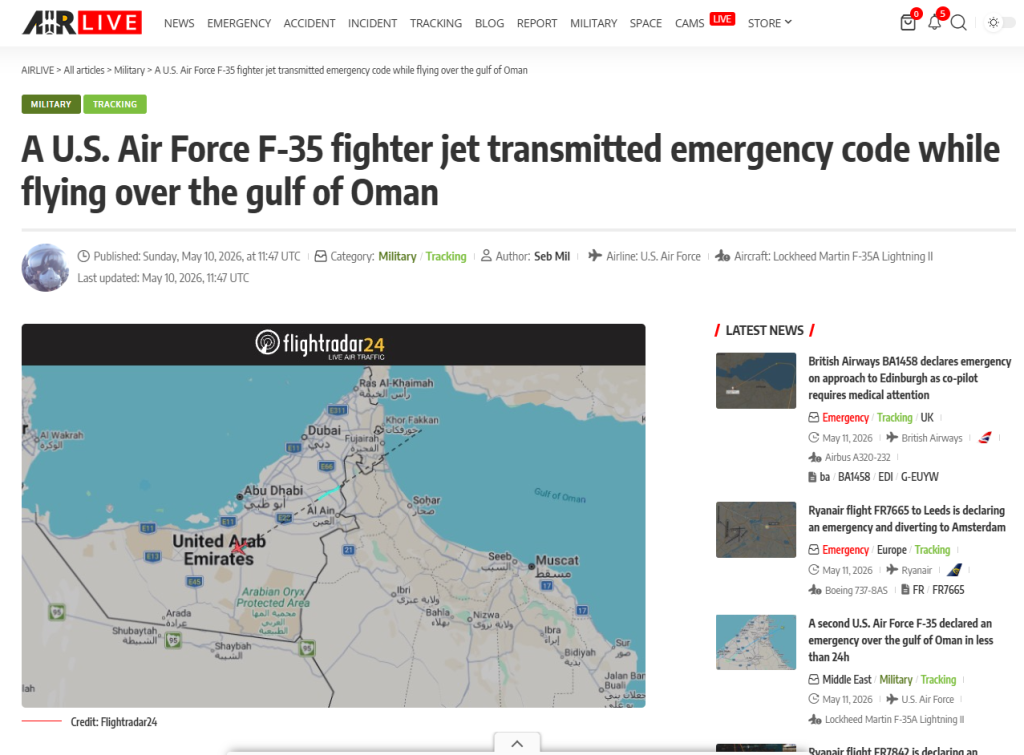
A screenshot of the AIRLIVE.net report, dated May 10, 2026.
In a subsequent report on May 11, 2026, it was revealed that a second U.S. Air Force F-35 fighter jet had issued an emergency signal over the Gulf of Oman within a 24-hour window. The report could be summarized that:
For the second time in less than 24 hours, a U.S. Air Force F-35 Lightning II fighter jet declared an in-flight emergency over the Gulf of Oman. In this latest incident, which took place in the early hours of Monday, the aircraft (registration 13-5067) was conducting a patrol mission at 15,000 feet when it broadcasted a ‘Squawk 7700’ general emergency signal. The jet subsequently altered its course toward the UAE, making a safe landing at Al Dhafra Air Base at 02:55 UTC.
This series of events had begun on Sunday, May 10, when another F-35 aircraft transmitted a similar emergency signal before returning to base. The back-to-back incidents have raised concerns regarding the reliability and operational status of the advanced fighter fleet in the region—particularly as they occurred within a highly strategic area. Al Dhafra Air Base serves as a primary hub for the U.S. Air Forces Central (AFCENT) in maintaining maritime security and regional stability across the Middle East.
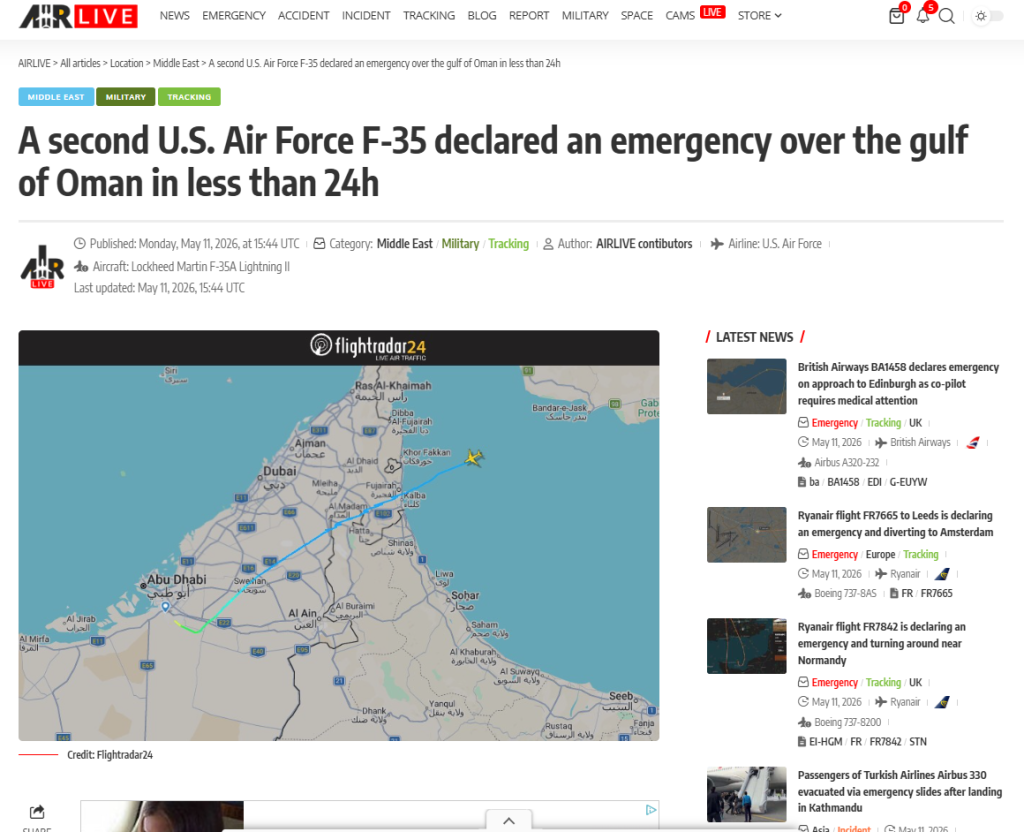
A screenshot of the AIRLIVE.net report on the second U.S. Air Force F-35 fighter jet incident.
Is it true that a U.S. destroyer fled Iranian vessels?
Utilizing InVID-WeVerify to isolate keyframes from the clip and verifying them through Google Lens, Thai PBS Verify discovered that the footage dates back to August 10, 2019. It was initially featured in an article by the Express website titled, ‘Iran claims gunboats chased down Royal Navy’s HMS Duncan – but here’s what really happened.’
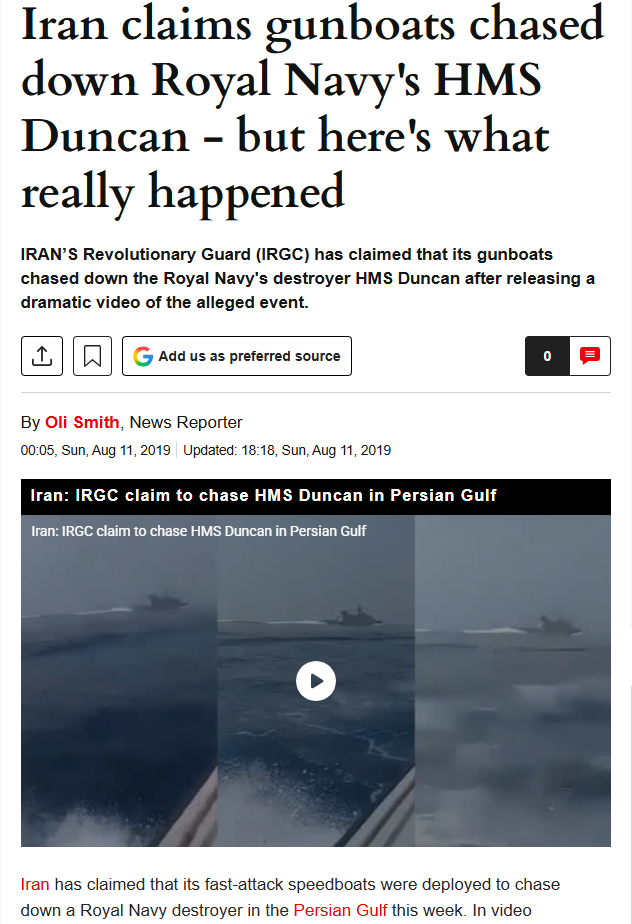
The Express website reported in August 2019 that Iran had claimed its gunboats chased down the Royal Navy’s warship, HMS Duncan.
The footage in question is identical to the video we investigated. Nevertheless, it dates back to a period of heightened hostilities between Iran and the UK in the Persian Gulf, meaning it does not showcase any recent retreat by a U.S. vessel under pressure from Iranian forces in the Strait of Hormuz.
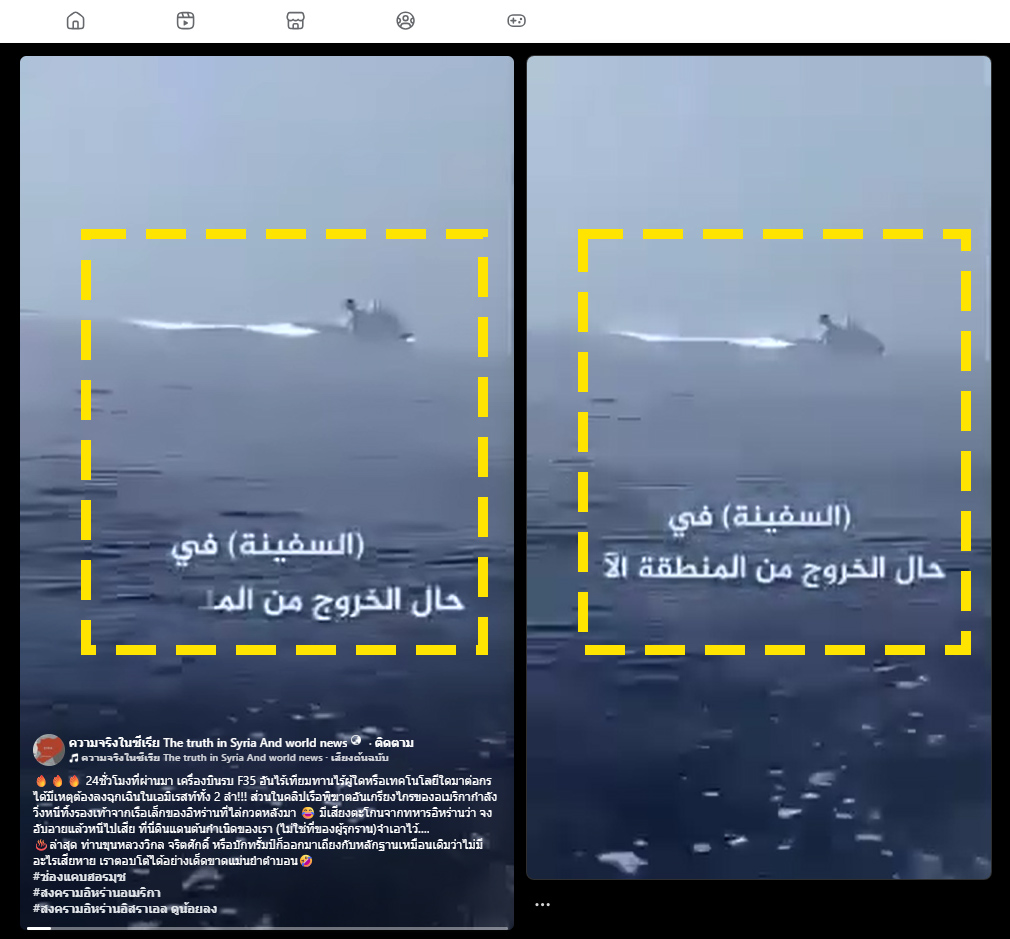
When extracted keyframes were compared with the 2019 clip, they were found to be identical.
In addition, the same event was covered in an August 10, 2019 report by The Sun. The article, which carried the headline ‘GULF THREAT Iran claims gunboats chased Royal Navy destroyer HMS Duncan in Strait of Hormuz as tensions rise in the Gulf,’ specified that:
“Iranian Revolutionary Guard officials released the short video allegedly showing the Type-45 destroyer being pursued by their fast attack boats.
“Video footage seemingly shows a warship sailing in the distance while a group of smaller boats follow behind at a distance.
“The boats appear to be armed with machine guns.
“It is unclear whether the warship in the clip is actually HMS Duncan.
“One MP said “not in a thousand years” in response to the ship being the Royal Navy destroyer.”
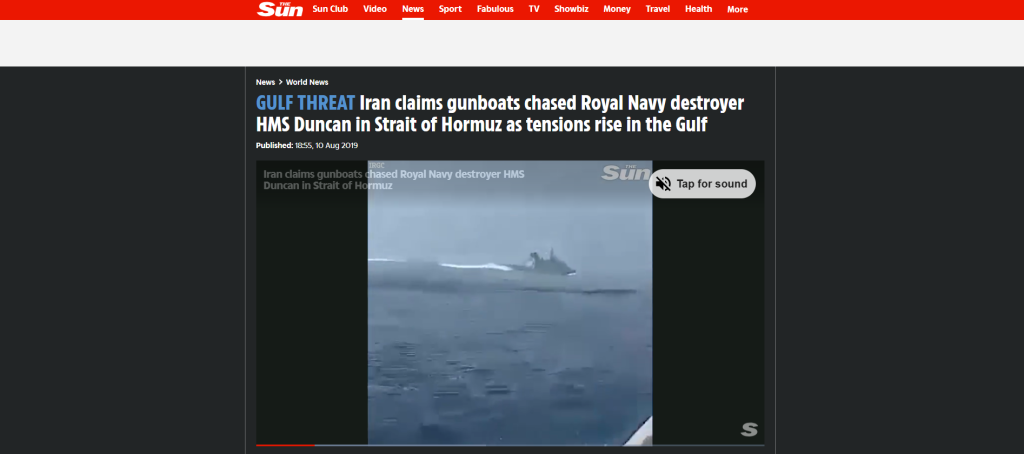
A news report by The Sun, which covered the same story on August 10, 2019.
Can it be verified if the vessel depicted in the video is indeed British?
Regardless, questions were also raised regarding the claims made at the time. The Sun cited an Iranian official who denied the incident. The Express noted that Type 45 destroyers stationed in the Persian Gulf were characterized by a prominent Sampson radar dome used to support the Sea Viper air defense missile system—a distinctive feature that was absent from the vessel in the video.
What is the truth?
The Facebook post in question mixed some real facts with fake news and an old video to mislead people. Here is the breakdown:
- The warship video (fake news): It is not from any recent event and does not show a U.S. warship. It is an old clip from August 2019, when Iran claimed it was chasing Britain’s HMS Duncan. The UK denied this, explaining that the ship in the video looked different from their Type 45 destroyers.
- The F-35 Jets (partly true, but decontextualized): It is true that on May 10–11, 2026, U.S. F-35A jets and refueling planes (KC-135R and KC-46) sent out an emergency 7700 code over the Gulf of Oman and Saudi Arabia, and made emergency landings in the UAE. This was reported by Xinhua and AIRLIVE.net. However, the source post linked this news to an old video of ships to make it look like the U.S. was losing a war.
Verification Process
Thai PBS Verify utilized digital tools to confirm the accuracy of the information, as detailed below:
- InVID-WeVerify: The team extracted keyframes from the video to identify pivotal still images of the event.
- Google Lens: The team conducted a reverse image search from extracted keyframes. The tool successfully traced the footage back to its original source in the 2019 news reports by Express and The Sun.
- Aviation source cross-checking: The 7700 emergency code was verified via Xinhua News Agency and AIRLIVE.net to confirm the actual flight status of the F-35 on the day of the incident
Potential impacts of misinformation
- Creating information chaos: By mixing authentic facts (the F-35 story) with an old video, the post blurs the line between truth and falsehood, making it challenging for readers to differentiate and highly susceptible to belief.
- Provoking conflict: Harsh words and political ridicule make international hatred even stronger.
- Damaging facts of actual situations: Framing a regular technical issue as a massive wartime event can generate undue anxiety, ultimately impacting regional economic performance and political trust.
What to do with this misinformation?
- Check the footage timeline: Military and combat fake news frequently relies on ‘recycled clips.’ Observe the image resolution and weather patterns—if they look outdated, it is safer to assume the footage is old.
- Analyze the language used: If a post contains an excessive number of emojis or employs sarcastic tone, be cautious, as it may be propaganda designed to drive a specific narrative.
- Adhere to reputable journalism: Always validate content against official reports or verified fact-check assessments before hitting share, thereby breaking the chain of fake news.