Commerce Minister Suphajee’s policy does not urge farmers to grow less rice
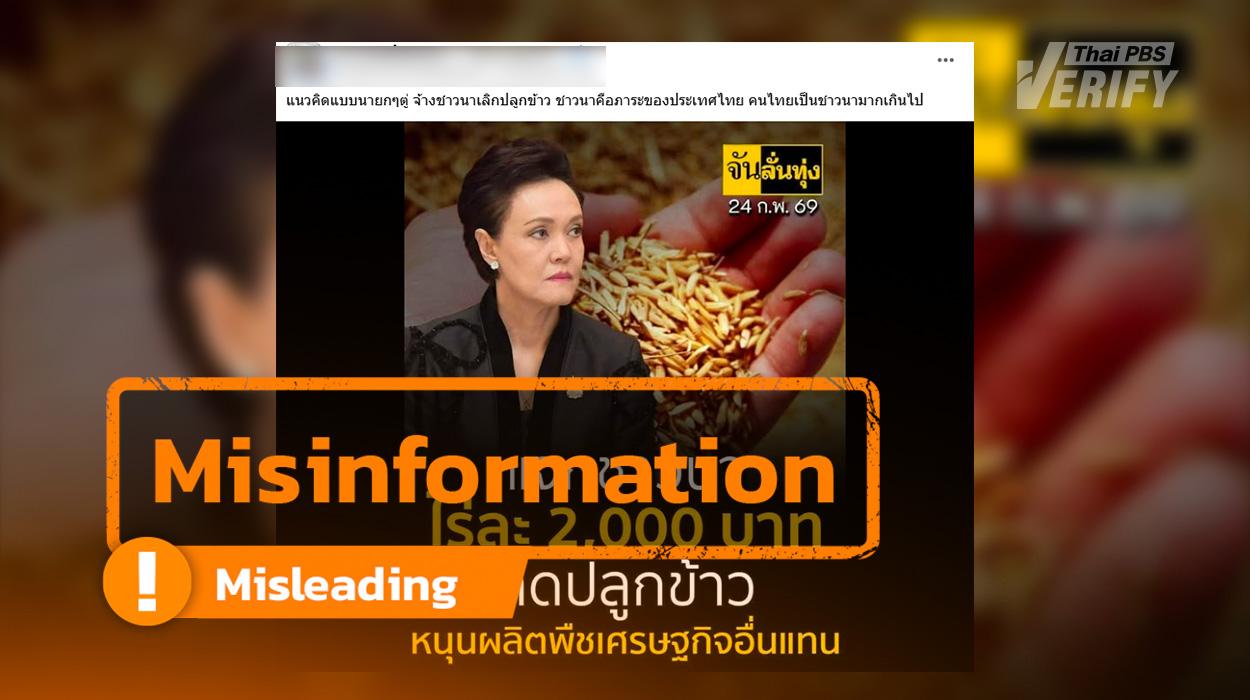
Thai PBS Verify found the piece of misinformation on: Facebook

A post on the ‘Free YOUTH’ Facebook group shared an image of Mrs. Suphajee Suthumpun with a caption stating, “2,000 THB per rai for farmers to reduce rice cultivation in favor of other cash crops.”
Thai PBS Verify identified a post on the ‘Free YOUTH’ Facebook group, featuring an image of Mrs. Suphajee Suthumpun, Thai Deputy Prime minister and Minister of Commerce. The graphic claims a 2,000 THB per rai (≈ 0.4 acre) subsidy is being offered to farmers to switch from rice to other cash crops.
The post’s caption further criticizes the idea, likening it to former PM Prayut Chan-o-cha’s policies: “This is like PM Tu (Mr. Prayut’s nickname)’s idea to pay farmers to quit cultivating rice. Farmers are Thailand’s burden. There’re too many Thais who have become farmers.”
Published on February 26, 2026, the post has garnered 84 comments and 62 reactions.
Is the 2,000-baht subsidy for crop substitution actually real?
Using the keywords ‘Suphajee Suthumpun (ศุภจี สุธรรมพันธุ์),’ Thai PBS Verify uncovered a video from a Bhumjaithai Party event held on December 24, 2025, where new members were introduced. The details are as follows:
“We are encouraging our brothers and sisters in each area to consider supplementary crops. To be clear, we aren’t asking you to abandon your current crops entirely, but to utilize a portion of your land for alternatives. We are providing a 2,000-baht subsidy per rai, capped at 10 rai per household—totaling 20,000 THB. To ensure success, the Provincial Commerce and Agricultural Extension offices will collaborate to assess soil quality, climate and local skills to determine the best crops. We don’t just help you plant; we secure the markets for you. This initiative has already been approved for one million rai.”

A video of Mrs. Suphajee from the Bhumjaithai Party’s official debut of new members on December 24, 2025.
Furthermore, another keyword search for ‘2,000 baht per rai subsidy (แจก 2,000 บาทต่อไร่)’ revealed a direct match with a previous news report.
On November 19, 2025, the National Rice Policy and Management Committee approved a 2,000-baht-per-rai subsidy—capped at 10 rai per household—to incentivize farmers to transition from second-crop rice to off-season alternative crops.
The details of the report are as follows:
“The National Rice Policy and Management Committee (NRPMC), chaired by Mr. Anutin Charnvirakul, has passed significant resolutions to optimize rice management. Key measures focus on absorbing surplus production and restructuring the sector. A central initiative includes a subsidy of 2,000 baht per rai (capped at 10 rai per household) to incentivize farmers to switch from second-crop rice to water-efficient, market-driven alternatives. Complementary strategies involve adjusting credit limits for delayed rice sales, extending interest subsidies for operators, and purchasing rice at above-market prices to balance supply. These efforts aim to promote high-quality rice production and stabilize the market to enhance long-term farmer income.”
Upon examination, the claim that Mrs. Suphajee is personally distributing 2,000 baht per rai to reduce rice cultivation is misleading. In reality, this is an official resolution by the National Rice Policy and Management Committee (NRPMC). The measure is designed to support farmers in transitioning from second-crop rice to “post-harvest crops”—providing a 2,000 baht subsidy (capped at 10 rai per household)—to encourage water-efficient farming that meets market demand, rather than simply reducing rice production.
What is the truth ?
Thai PBS Verify finds the post to be “partially true,” but misleading in its presentation. During the Bhumjaithai Party’s 2026 election campaign launch, Mrs. Suphajee clarified that such initiative was designed to offer farmers alternative crop options on their own land. It is not a direct cash handout, nor was it a personal decision; rather, it is a formal resolution passed by the National Rice Policy and Management Committee (NRPMC).
Verification Process
- Keyword search analysis: A search for ‘Suphajee Suthumpun’ revealed that her remarks during the Bhumjaithai Party launch referred to the policy as an additional option for farmers to diversify their crops. The policy aims to complement existing rice farming, not to mandate a total replacement of rice with alternative crops.
- Keyword cross-referencing: A search for ‘Suphajee Suthumpun’ led to a direct match with an official report regarding the National Rice Committee’s resolution. Published on November 19, 2025, the news confirms the approval of a 2,000-baht-per-rai subsidy (up to 10 rai per household) specifically for transitioning from second-crop rice to off-season alternative crops.
Potential impacts of misinformation
- Misguided decision-making: Farmers may delay their rice cultivation or pivot their investments toward other crops in anticipation of the rumored subsidies. If these claims prove false, it could lead to significant lost opportunities and wasted capital, leaving farmers with no financial returns for their efforts.
- Social inequality and community disputes: Rumors of financial handouts often fuel high expectations. If some groups mistakenly believe they are eligible while others are not, it can trigger internal conflicts and a wave of futile complaints to local authorities, placing an unnecessary burden on public offices.
- Distortion of official policies: The misinformation misrepresents the “supplementary crops” initiative, which is designed to provide additional options rather than mandate a reduction in rice farming. Such claims create public confusion, making it difficult for citizens to distinguish between legitimate support measures—such as fertilizer subsidies—and fabricated ones.
- Vulnerability to scams: Misleading claims often serve as bait for scammers. Fraudsters may lure farmers into clicking malicious links under the guise of “signing up” for cash aid, only to steal their identity or wipe out their life savings. This turns a simple misinformation issue into a serious financial threat.
What to do with this misinformation?
- Verify the source: If the information originates from a personal account, an unofficial page, or a website with an unusual URL, please exercise caution and assume it may be misinformation until proven otherwise.
- Identify red flags in the content: Misinformation often employs emotionally charged language—such as “Urgent,” “Guaranteed payouts for all,” or “Share before this gets deleted”—to trigger an impulsive reaction and encourage sharing without critical thinking.
- Don’t share: Be mindful that sharing fake news can lead to legal action under the Computer Crime Act, especially if it incites public panic or threatens economic stability. Protect yourself and others by double-checking before you click ‘share.
- Report and remind: When someone in your circle shares a false claim, reach out to them gently with the real story. Sharing a trusted source like Thai PBS is an effective and respectful way to help them realize the error and encourage them to delete the post for the public good.
- Master media literacy: Recognize that false claims are frequently crafted to serve political agendas or simply to generate views. By understanding these underlying motives, you can stay calm and detached, preventing fake news from clouding your judgment or causing unnecessary irritation.
Translation edited by: Peerachai Pasutan