Trend to forward “Object to Meta use of personal photos” messages found to be chain letter
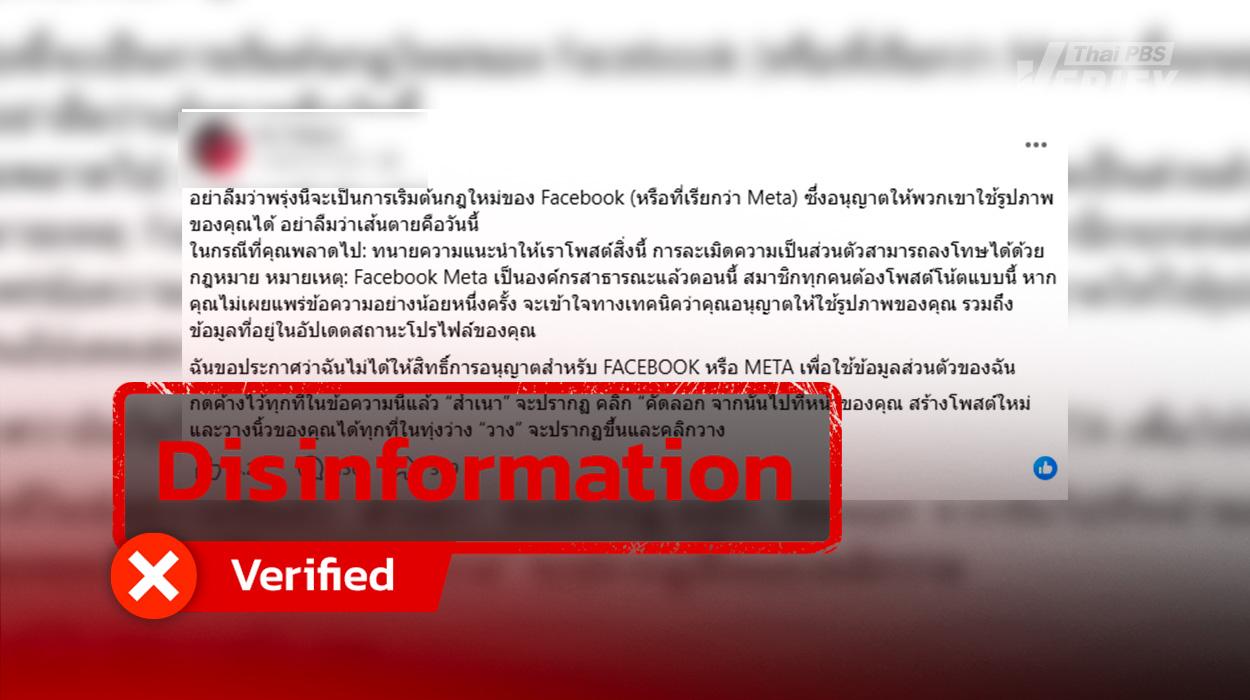
Recently, a representative from Meta Thailand has confirmed to Thai PBS Verify that such messages are untrue. Reposting them does not help protect personal data in any way. However, users can manage their privacy settings as usual on its platforms’ standard features.
Thai PBS Verify found the piece of disinformation on: Facebook
On April 8, 2026, began the dissemination of messages inviting users to copy and post a statement to “object” to Meta using personal data, such as photos, for other purposes. The widespread sharing of this content raised several questions to some people. Why had so many users published such messages? Was it factually true? Could copying and reposting the text actually protect or deny permission for the platform to use personal data?
Furthermore, additional doubts were raised regarding whether posting such statements as a Facebook status holds any legal weight or could truly serve as an immediate formal declaration of objection. This trend timely occurred amidst growing privacy concerns among Facebook users.
The messages read:
“Don’t forget that tomorrow marks the start of the new Facebook (now known as Meta) rule, which allows them to use your photos. Remember, the deadline is today.
“In case you missed it: lawyers advise us to post this text. Privacy violations can be punished by law.
“Note that Facebook Meta is now a public entity. All members must post a note like this. If you do not publish this statement at least once, it will be technically understood that you permit the use of your photos, including the information contained in your profile status updates.
“I hereby declare that I do not grant permission for FACEBOOK or META to use my personal data.
“Hold your finger anywhere on this text and “Copy” will appear. Click “Copy,” then go to your page, create a new post, and place your finger anywhere in the empty field. “Paste” will appear, click paste.”
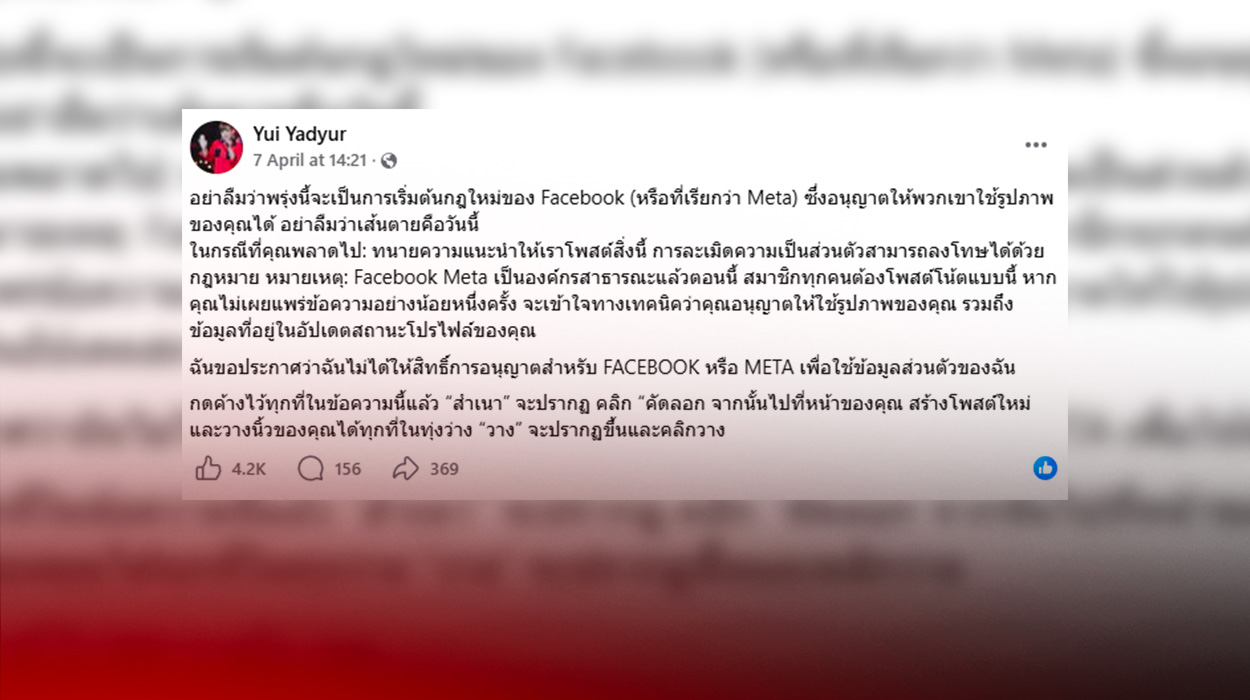
A screenshot of the post by Thai singer ‘Yui Yadyur,’ who also shared the messages of this nature.
Messages in question are ineffective, but users can change their privacy settings
Thai PBS Verify reached out to a representative of Meta Thailand. While the company has not issued additional official communications regarding this specific case, they confirm the messages currently being forwarded are false. Furthermore, the protection of users’ personal data remains in accordance with Meta Privacy Policy.
The company’s privacy policy states that Meta typically collects personal data from activities and information provided by users to the platforms, such as posts or content in any forms (text, comments and audio). Data from camera features can also be gathered and utilized to develop various features, such as masks, filters, avatars and effects.
Furthermore, this includes interaction data and related information, such as communications that users or others exchange with Meta AI, the types of content and advertisements users view or interact with, and usage patterns like the time, frequency and duration of platform activity.
Regarding transactions, the policy states that information is collected about purchases or transactions conducted through Meta’s payment systems, including relevant details such as credit card information (where applicable). It also covers hashtags used, selfie photos or videos provided when contacting support, as well as data concerning friends, followers, connected individuals, device information and applications integrated with the platform.
As for the purpose of data collection, Meta specifies that such information is used to develop and improve services. This includes enhancing system safety and reliability and ensuring legal compliance. Further uses of the data include optimization of advertisements and content to individual users, refined features development and user behaviors analysis.
However, Meta explicitly states that the company does not sell users’ personal information to third parties. Users can manage their own privacy rights through the Help Center, as well as via Facebook and Instagram account settings and device-level settings, to manually control and monitor their privacy status.
Additionally, users can exercise their right of objecting to data use by navigating to Settings > Privacy Center >AI at Meta. In certain countries (including Thailand for specific features), there is a button to directly object to the use of data for AI training.
In conclusion, if you encounter messages of this nature, you should not share them. If such messages are received from a stranger. Especially if it involves solicitations for financial transactions. It should be suspected as a potential scam by fraudsters.
What is the truth?
Messages claiming that copying and posting an objection to Meta’s use of personal data are merely a “chain letter.” It has been forwarded for years. Such posts hold no legal weight and are entirely unrelated to Meta’s actual policies. Usage of user data remains governed by the company’s Privacy Policy, which users agree to upon signing up. Users can, however, manage their own privacy settings directly through Meta platforms’ features. Consequently, posting such statements cannot be used to officially object to or prevent data usage. Users are encouraged to verify information before sharing to avoid spreading hoaxes.
Verification Process
- Inquiry with Meta Thailand: Although the company has not issued additional communications regarding this matter, they confirm the messages currently being forwarded are indeed false. Furthermore, the protection of users’ personal data remains governed by MetaPrivacy Policy.
Impacts of disinformation
- Misunderstanding of legal rights: Users may believe that posting these messages can actually “object” to data usage by Meta, when in reality, rights and data practices are governed by the company’s policies, not by messages posted by the users themselves.
- Increasing the spread of disinformation: Sharing without verification allows false information to spread widely, creating confusion within the online community.
- Creating unnecessary panic: These messages often use urgent language, such as “deadline today” or “must post immediately,” which causes users to feel fearful and rush to share without careful consideration.
- Distracting from correct protective measures: Users may waste time copying and pasting posts, instead of actually adjusting their privacy settings or studying the platform’s genuine policies.
- Increased vulnerability to other scams: Becoming accustomed to believing and sharing these types of messages, users may become targets for fraudsters who use similar tactics to trick them into making financial transactions or revealing sensitive personal information.
What to do with this misinformation?
- Stop and verify the source before sharing: Consider whether the information comes from a credible source, such as an official agency or a direct announcement from Meta.
- Do not fall for messages with a false sense of urgency: Content using words like “Urgent,” “Must do immediately,” or “Deadline today” are common tactics used to incite sharing. You should remain skeptical; there is no need to copy or repost such messages.
- Posting such messages does not protect personal data and holds no legal weight: Adjust privacy settings directly on the platforms, such as Facebook, to control who can view your information.
- Beware of messages linked to requests for data or money: If there is an invitation to fill in personal details, click a link or perform a transaction, you should avoid it immediately, as it may be a deceptive tactic used by scammers.
Translation edited by: Peerachai Pasutan